

Here’s something that might sting a little: You probably think your marriage is more progressive than your parents’. You split the mortgage, you both have careers, maybe you even alternate who picks up dinner. But if you’re exhausted, resentful, and feeling like you’re managing everything while your partner just… exists in the space you’ve created, congratulations – you’re living what sociologist Arlie Hochschild called “The Second Shift.” And it’s not 1989 anymore.

I’m Felicia Kashevaroff, an ICF-certified relationship coach and founder of Tend Task, and today we’re talking about why modern marriages are running on ancient programming, and why all your good intentions about equality aren’t enough to override decades of gender socialization that started before you could even talk.
Marriage problems exhaustion isn’t a personal failing – it’s a predictable outcome when contemporary relationships operate on outdated systems that create invisible inequality.
The Stalled Revolution: Why Gender Equality Stopped Halfway
Let’s start with some research that’s going to make a lot of you uncomfortable. Arlie Hochschild coined the term “The Second Shift” in 1989 to describe how working women come home to essentially a second full-time job of household management and childcare. But here’s what she observed next: what she called “The Stalled Revolution.” Women entered the workforce en masse, but the second shift of domestic labor never got redistributed. The revolution toward gender equality just… stopped halfway.
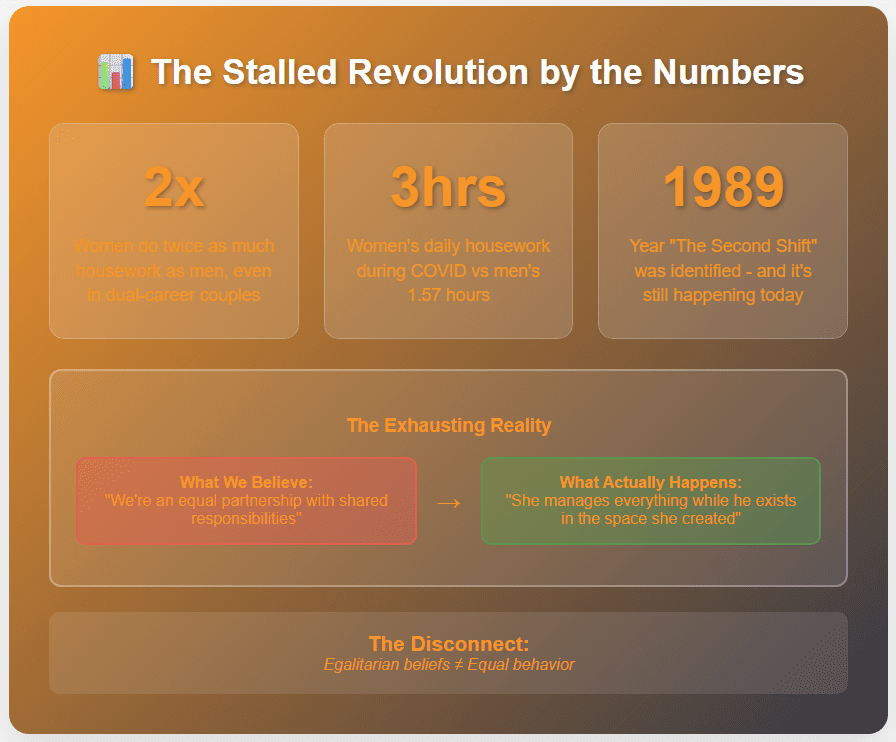
Reality Check: Women still do 2x the housework of men
Recent research shows that even in dual-career couples, women still perform approximately twice as much housework and childcare as men. During COVID-19, when both partners were working from home, women increased their daily housework from 2.5 hours to 3 hours. Men? They went from 1.26 to 1.57 hours. Even when men could tangibly see the work that needed to be done, the gap actually widened.
Hochschild identified three types of “gender ideologies” that shape how couples approach domestic responsibilities:
The Three Gender Ideologies

Traditional ideology says women handle the home, men handle the paycheck. Pretty straightforward.
Egalitarian ideology says responsibilities should be shared equally regardless of gender.
Transitional ideology – and this is where most of you probably live – says both partners can work, but women are still primarily responsible for the home and children. You might help each other out, but there’s an understood default.
The kicker? Research consistently shows that even partners who both identify as having egalitarian ideologies still end up in traditional patterns. This disconnect between expectations and outcomes creates deep resentment and disappointment for modern couples who can’t understand why their “equal” relationship feels so unequal.
The Disconnect: Egalitarian beliefs ≠ Equal behavior
And before anyone says “Well, maybe women are just naturally better at this stuff” – let me stop you right there. There’s nothing in our DNA that makes women inherently better at remembering when the pediatrician appointment is or knowing that we’re out of toilet paper. These are learned behaviors, and we’ve all been learning them since birth. Research on gender socialization confirms these are cultural patterns, not biological imperatives.
The Programming You Can’t See
What’s really happening in your “modern” marriage? You’re operating under what researchers call “intensive mothering ideology” and “hegemonic masculinity” – which are academic terms for “women should be perfect mothers and household managers” and “men should be providers and fixers, not nurturers.”
The Invisible Programming
This programming is so deep that it affects couples who swear they don’t believe in gender roles. I see this consistently in my coaching practice: partners who genuinely believe in equality but somehow always default to more traditional behaviors.
Let me give you an example that might sound familiar: You both work full-time. You both believe in sharing responsibilities. But when the baby gets sick, who automatically takes time off work? When you’re having friends over for dinner, who’s mentally planning the menu, grocery list, and clean-up strategy? When your kid needs a Halloween costume, who’s already three Pinterest boards deep in DIY ideas?
“It’s not just about who does the dishes – it’s about who remembers the dishes need to be done.”
This is what researchers call the “mental load” – the cognitive labor of running a household. The really insidious part? Because it’s invisible, the person carrying it (usually women) feels crazy for being overwhelmed by something their partner can’t see.
Recent longitudinal research shows these patterns are so predictable that researchers can actually forecast which couples will fall into traditional arrangements based on their pre-marriage gender ideologies – even when both partners claim they want equality.
Plot Twist: Your childhood gender socialization predicts your marriage patterns
Think about it – if you grew up watching mom manage the household while dad provided financially, that’s your blueprint for “how relationships work,” regardless of what you intellectually believe about gender equality. Our brains are pattern-matching machines, and the patterns we learned earliest are the strongest.
The exhaustion comes in because modern marriages ask women to be full-time career professionals AND perfect mothers AND household CEOs while asking men to be good providers AND maybe help out when asked. One of these is a sustainable workload. The other is a recipe for burnout.
Why Good Intentions Aren’t Enough
What keeps couples from deciding to be equal partners and just making it happen? It’s because changing behavior requires more than good intentions – it requires dismantling the systematic programming that has been in place for generations.
Systemic Problem #1: Default Assumptions
In most relationships, childcare, household management, and emotional labor default to women. It’s not that men can’t do these things – it’s that the systems assume women will, so men have to actively opt in while women have to actively opt out. And opting out feels selfish because we’ve been socialized to believe this is “women’s work.”
Systemic Problem #2: Competency Myths
I can’t tell you how many times I’ve heard “She’s just better at organizing” or “He doesn’t notice when things are dirty.” These aren’t biological differences – they’re learned helplessness and learned hypervigilance. When society tells women they’re responsible for domestic perfection and tells men their contributions don’t really matter, people live up (or down) to those expectations.
Research on gender and household labor shows that these competency myths are socially constructed and reinforced through childhood socialization.
Systemic Problem #3: The Praise Gap
Third, and this one will make you angry: men get praised for basic parenting and household contributions while women get criticized for not doing enough. Dad changes a diaper at a restaurant? What a great father. Mom forgets to pack snacks? She’s neglecting her children. This praise gap reinforces the idea that domestic work is women’s domain and men are just “helping out.”
A 2020 study found that during the pandemic, when household inequality became visible to male partners, many men expressed shock at how much their wives were actually managing. As one NPR report put it, the pandemic made “grotesque inequality” visible to partners who previously had no idea.
The hopeful reality? When couples consciously address these systems instead of just hoping equality will happen naturally, they can create actual change.
What Actually Works: Research-Based Solutions
So, what does research say actually creates lasting equality in relationships? Three evidence-based approaches:

Solution #1: Make the Invisible Visible
This means actually documenting who does what – not just the obvious tasks like dishes and laundry, but the invisible labor like meal planning, social coordination, and child development tracking. Research consistently shows that couples who explicitly discuss and map household responsibilities report higher relationship satisfaction and more equitable divisions.
Tools like Fair Play by Eve Rodsky provide systematic approaches to documenting and redistributing domestic labor.
Solution #2: Challenge Default Assumptions
Instead of one partner “helping” the other with household tasks, both partners need to be fully capable and responsible for all aspects of running your shared life. This means both of you should be well-versed in carrying all facets of any task – anticipating needs, doing research, making decisions, and following up to see what worked. No more learned helplessness or default managers.
Studies on household labor redistribution show that couples who challenge default assumptions create more sustainable egalitarian arrangements.
Solution #3: Design Systems, Not Intentions
Research shows that couples who create explicit systems for sharing domestic responsibilities maintain more egalitarian arrangements over time than couples who just try to “be more equal.” This includes everything from weekly planning meetings to trading off who handles morning routines.
Evidence-based tools like our Tend Task: Household Organizer are designed specifically to help couples share the mental load through systematic approaches rather than relying on good intentions.
Couples who successfully create egalitarian relationships report that it actually strengthens their partnership. When both people feel truly supported, intimacy increases. When both people have agency in their relationship, resentment decreases.
Professional Resources for Creating Equality
If you’re struggling with persistent inequality despite good intentions, consider these research-backed resources:
Relationship Support:
- Gottman Method couples therapy with focus on fairness and friendship
- Emotionally Focused Therapy for addressing underlying attachment and power dynamics
- International Coach Federation certified relationship coaches
Household Management Systems:
- Fair Play methodology for comprehensive domestic labor redistribution
- Cozi family organizer for shared calendar and task management
- Tend Task for mental load distribution and relationship equity
Educational Resources:
- The Second Shift by Arlie Hochschild
- All the Rage by Darcy Lockman on motherhood and marriage inequality
- The Politics of Housework classic essay by Pat Mainardi
The Path Forward: Intentional Change
Here’s what I want you to remember: your exhaustion isn’t a personal failing, and your relationship struggles aren’t because you’re not trying hard enough. You’re fighting against decades of programming that taught you what “normal” relationships look like.
Key Takeaways:
- Modern marriages still run on ancient programming
- Gender ideology shapes behavior more than conscious beliefs
- Equality requires systems, not just good intentions
- Change is possible but it has to be intentional
The good news? Once you see the system, you can change it. But it requires both partners to acknowledge that good intentions aren’t enough – you need to actively redesign how your relationship works.
Research on successful egalitarian couples shows that intentional redistribution of domestic labor leads to higher relationship satisfaction, better physical and mental health for both partners, and more positive modeling for children.
For more strategies on creating truly equitable partnerships, visit Tend Task where we help couples move beyond good intentions to create relationships that actually work for everyone involved.
Remember: you have the power to create the truly equal partnership you both deserve. But it starts with seeing the invisible systems that shape your relationship – and choosing to change them.


